Featured In





Trauma Informed Coaching Certification
An examination-based board certification in trauma informed coaching. Earned through 125 hours of trauma informed coach training that combines executive function coaching foundations with advanced trauma neuroscience.
paid in full, or as low as $307/month with Klarna · 125 training hours · 100% online
Personal Credential Pathway Assessment
Before beginning your board certification journey, many candidates choose to take the Personal Credential Pathway Assessment. This brief professional questionnaire helps the Board identify which credential pathway best fits your background, education, and career goals.
After completing the assessment, you will receive your results from the Board within minutes outlining your recommended credential pathway and next steps for enrollment.
Take the Pathway AssessmentTrauma informed coaching certification through NBEFC is an examination-based board credential earned through 125 hours of trauma informed coach training. The program awards two board credentials, Board Certified Executive Function Coach and Board Certified Trauma Informed EF Coach, through one 100% online dual track program. Tuition is $7,350 paid in full, or as low as $307/month with Klarna financing, subject to approval. There are no prerequisites. Candidates complete 85 hours of executive function coaching foundations, pass the independently proctored NBEFC board examination, then complete 40 hours of advanced trauma informed coach training covering trauma neuroscience, polyvagal theory, nervous system regulation, window of tolerance assessment, and safety-first coaching frameworks.
What Is Trauma Informed Coaching Certification?
Trauma informed coaching certification is a professional credential that verifies competency in applying trauma neuroscience to coaching practice. Trauma informed coaches work with clients whose nervous systems and executive function have been shaped by adverse, chronic, or overwhelming experiences. They understand how trauma disrupts attention, regulation, planning, and follow-through, and they adapt their coaching approach accordingly.
The NBEFC trauma informed coaching certification is examination-based. That means competency is verified through an independently proctored board examination, not through attendance alone. Most coaching certifications issue a certificate when a candidate finishes the training. NBEFC issues a board credential only when the candidate demonstrates competency by passing the exam. That distinction matters to clients, employers, and clinical teams who verify credentials before referring or hiring.
The official credential awarded is Board Certified Trauma Informed EF Coach. It is earned alongside the Board Certified Executive Function Coach credential through a single 125-hour dual track program, listed in the public NBEFC registry with a unique credential ID, and issued under the federally registered NBEFC mark.
Why trauma informed coaching is its own discipline
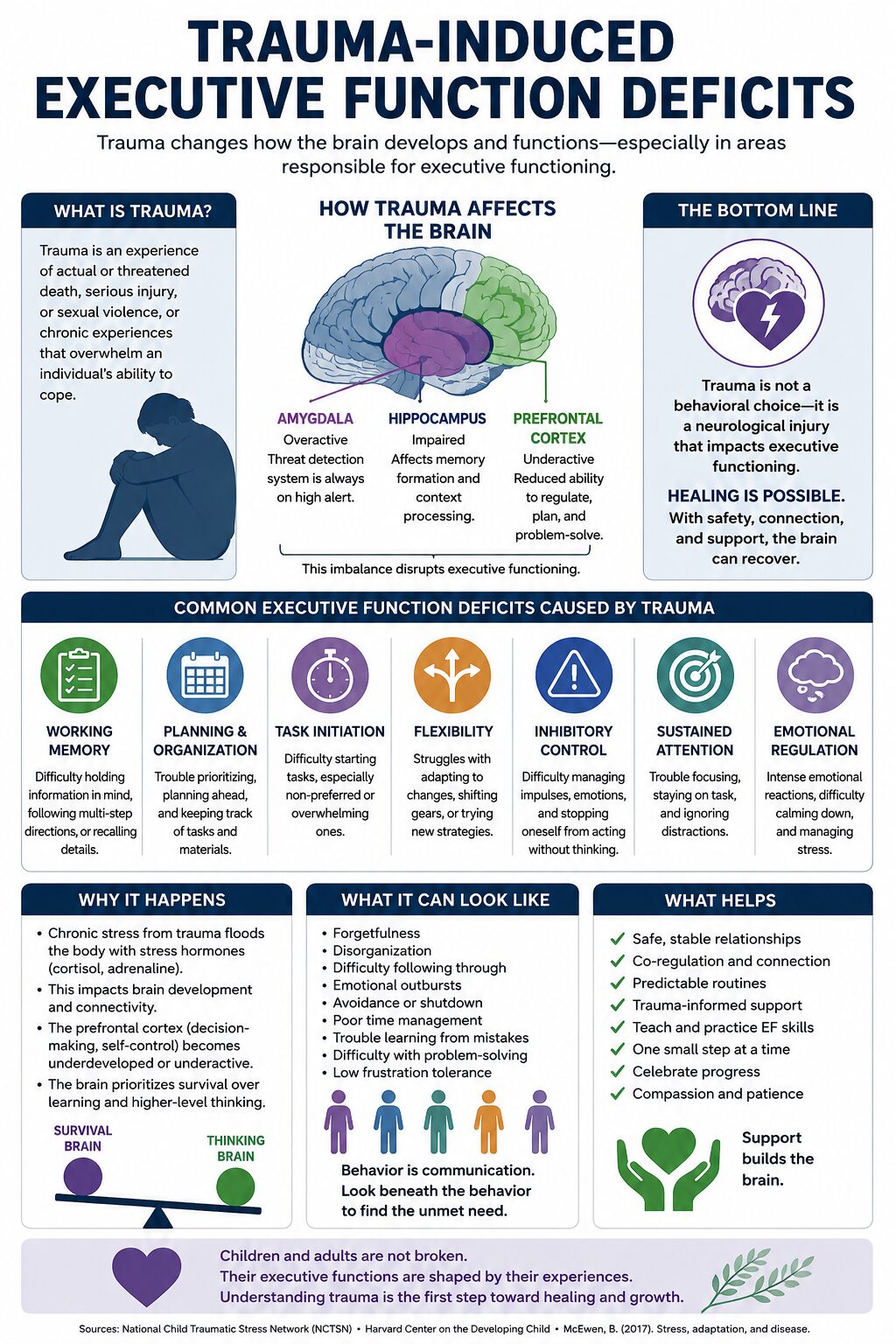
Trauma activates the HPA axis and elevates cortisol, which suppresses prefrontal cortex activity. The prefrontal cortex is the region responsible for planning, working memory, impulse control, and decision-making. When the nervous system is in chronic activation, those executive function resources are redirected toward threat detection. The result is a client who cannot plan or follow through, not because they lack the skills, but because their brain is not running the planning software while their nervous system is in survival mode.
Hypervigilance hijacks attention. Survival responses (fight, flight, freeze, fawn) override inhibitory control. Emotional flooding collapses cognitive flexibility. These are state-dependent deficits produced by nervous system activation, and they require different coaching strategies than the trait-based executive function challenges associated with ADHD. Coaching approaches that work well for one profile can fail or backfire with the other.
A trauma informed coach recognizes this distinction. They assess whether a client is within the window of tolerance before introducing cognitive work. They create environmental, relational, and internal safety as neurobiological prerequisites. They sequence bottom-up regulation before top-down strategy. And they recognize when client behavior reflects neurobiology rather than character.
What Is Trauma Informed Coach Training?
The 125-hour training pathway that leads to NBEFC trauma informed coaching certification.
Trauma informed coach training prepares coaches to work with clients whose executive function and nervous system have been shaped by trauma. NBEFC trauma informed coach training is 125 hours total: 85 hours of executive function coaching foundations plus 40 hours of advanced trauma informed specialty content. The training is 100% online and self-paced, with 365 days of materials access from the date of enrollment.
The 40-hour trauma informed specialty covers content that most coaching programs do not address at the depth this credential requires:
Trauma Neuroscience
The HPA axis, cortisol, amygdala activation, and how chronic stress reshapes brain architecture. Why this matters for every domain of executive function coached.
Polyvagal and Window of Tolerance
Polyvagal theory applied to coaching practice. Assessing nervous system state and recognizing when EF coaching is neurobiologically possible versus when regulation must come first.
Nervous System Regulation
Bottom-up regulation strategies, co-regulation in the coaching relationship, and sequencing somatic regulation before cognitive strategy.
Survival Response Patterns
Fight, flight, freeze, and fawn in coaching contexts, including how fawn can operate invisibly within the coaching relationship itself.
Trauma vs ADHD Differential
Identifying overlapping presentations and adapting coaching approach without overstepping diagnostic scope. State-dependent versus trait-based EF deficits.
Safety-First Coaching Framework
Environmental, relational, and internal safety as neurobiological prerequisites for EF skill-building. The order in which trust, regulation, and strategy must be sequenced.
Trauma Types and EF Signatures
Acute, chronic, complex developmental, intergenerational, and ACE-related trauma each produce distinct EF profiles requiring distinct coaching adaptations.
Trauma Informed Life Coaching
Adapting trauma informed strategies for adult life-coaching contexts including work, relationships, parenting, and goal pursuit within survival-shaped nervous systems.
Cross-Setting Coordination
Collaborating with therapists, educators, and caregivers. Maintaining clear coaching scope while supporting clients across clinical and life contexts.
How to Become a Trauma Informed Coach
The four-step pathway to NBEFC trauma informed coach certification.
The Four-Step Pathway
- 1Complete 85 hours of executive function coaching training. The clinical foundation that trauma informed coaching requires. Includes the Neurocognitive EFTech System with 137 ready-to-use intervention elements across all eight executive function domains.
- 2Pass the independently proctored NBEFC board examination. Your board exam is delivered and proctored through an independent third-party. Earn the first credential, Board Certified Executive Function Coach (NBEFC-C, NBEFC-E, or NBEFC-T depending on professional background), through verified competency rather than attendance alone.
- 3Complete 40 hours of trauma informed coach training. Advanced specialty content covering trauma neuroscience, polyvagal theory, nervous system regulation, window of tolerance assessment, survival response patterns, and safety-first coaching frameworks.
- 4Earn the trauma informed coach certification. Board Certified Trauma Informed EF Coach. Listed in the NBEFC public registry with a unique credential ID for verification by clients, schools, and clinical teams.
Why the Executive Function Foundation Matters
Trauma is, at its core, an executive function condition. The 85-hour foundation gives the credential its depth.
Trauma is not a separate topic from executive function. Every domain of executive function (working memory, cognitive flexibility, inhibitory control, emotional regulation, planning, task initiation) is directly affected by trauma activation. Coaches who work without an EF framework miss the mechanism. Coaches who have one can reach clients that general approaches cannot.
The 85-hour foundation covers eight domains examined on the board examination: Foundations of Executive Function, Neuroscience of EF, Education and Classroom Applications, Clinical and Therapeutic Applications, CBT-Informed EF Coaching, Coaching and Applied EF Strategies, Ethics in EF Practice, and Cognitive and Emotional Influences on EF. Each domain is examined. Each is built on directly by the 40-hour trauma specialty.
This is what separates a board credential from a certificate of completion. A board credential verifies depth across a coherent framework. A certificate confirms attendance. The NBEFC trauma informed coaching certification is the dual-track integration: clinical foundation plus trauma specialty, both verified by examination.
Who Should Pursue Trauma Informed Coach Certification
Practitioners who work with trauma-affected clients and want a verified credential to back the work.
Life Coaches Adding Trauma Specialization
Life coaches whose clients carry trauma histories, adverse childhood experiences, or chronic stress that disrupts goal pursuit. Trauma informed life coach certification adds verified competency to a coaching practice and supports premium positioning.
Therapists Adding a Coaching Credential
Occupational therapists, social workers, school psychologists, and mental health professionals can earn the NBEFC-T designation alongside both board credentials, reflecting clinical background while adding structured coaching tools.
Coaches Working with Foster Care and Adoption
Specialize in children and families navigating developmental trauma. Foster care, adoption, and ACE-affected populations require trauma-informed approaches that general coaching credentials do not provide.
School-Based Coaches and Educators
Add board-level credentials to school-based EF roles. Trauma informed coach certification supports work with students whose nervous systems have been shaped by adverse experiences.
Career Changers
Professionals from any background entering trauma-aware coaching. No prior coaching experience required. The dual track builds both credentials from foundations through one enrollment.
Coaches with Lived Experience
Lived experience is a real asset. The credential adds professional verification, trauma neuroscience depth, and a structured framework to the understanding coaches already bring to clients navigating trauma.
Certificate of Completion vs Examination-Based Board Certification
The structural differences between an attendance-based certificate and a board-issued credential verified by examination.
| Feature | Certificate of Completion | NBEFC Examination-Based Board Certification |
|---|---|---|
| Credential Type | Certificate | Board certification ✓ |
| Competency Verification | Attendance-based | Examination-based ✓ |
| Executive Function Foundation | Varies | 85 hours of EF coach training ✓ |
| Intervention System | Varies | 137-element Neurocognitive EFTech System ✓ |
| Client-Ready Practice Materials | Varies | White Label Business Vault, unbranded and editable ✓ |
| Public Registry | Varies | Yes, with unique credential ID ✓ |
| Governing Body | Training provider | National board, federally registered mark ✓ |
| Code of Ethics | Varies | Required and enforceable ✓ |
| Credentials Earned | One certificate | Two board certifications ✓ |
What Board Certified Trauma Coaches Earn
Income for board certified coaches falls into two distinct paths. Most salary articles conflate them, which understates what is possible.
Path One: Employed at a Coaching Company
Salaried positions at established companies like Beyond BookSmart. Steady income, structured caseloads, no client acquisition burden.
Path Two: Private Practice / Per-Session
Independent practice where the coach sets rates and builds a client base. Income scales with credential, niche, and pricing strategy.
Where the Trauma Specialty Adds Earning Power
Holding both Board Certified Executive Function Coach and Board Certified Trauma Informed EF Coach credentials creates rare positioning for clinical teams, schools, and families seeking coaches who can complement therapy with trauma-aware skill building. The included NBEFC Business Blueprint provides the practical framework for niche definition, pricing, and client acquisition.
What is Included in the Dual Track
Everything needed to earn both board credentials, in one program, in one enrollment.
Trauma Informed Coaching Certification Includes
- 85 hours of executive function coach training across eight examined domains
- 40 hours of trauma informed coach training covering trauma neuroscience, polyvagal theory, nervous system regulation, window of tolerance, safety-first frameworks, and lifespan applications
- Unlimited access to the Neurocognitive EFTech System with 137 intervention elements
- 5 full randomized practice exams for board examination preparation
- 50 mock session profiles to practice real coaching before working with paying clients
- Independently proctored board examination fee included, delivered and proctored through an independent third-party
- Peer Mentorship Session, one business planning session with a Board Certified Executive Function Coach after you pass the board examination
- Two board credentials: Board Certified Executive Function Coach and Board Certified Trauma Informed EF Coach
- 2 years of public registry listing with unique credential ID
- NBEFC Business Blueprint included at no additional cost
- The White Label Business Vault, a full library of unbranded, editable coaching materials ready to carry your own logo
- ESA, HSA, and FSA Provider Pathway, a specialty course on education savings account, health savings account, and flexible spending account funding pathways, with 16 lessons, 15 editable forms, and an annually updated State Annex. A $950 value.
- xTiles for Coaches and Clients, a full course on the workspace system, plus a custom coach template and a custom client template built for NBEFC through our partnership with xTiles
- 365 days of access to all training and exam materials from purchase
- 100% online, asynchronous, self-paced · ADA compliant with closed captions
Build Your Practice From Day One
Every candidate receives the NBEFC Business Blueprint with access from the day you enroll, an interactive, step-by-step system built around four domains, Product, Platform, Traffic, and Retention, that walks you through finding your niche, building your website, getting found through search, and keeping the clients you win.
Product
Your coaching niche, offer, and brand. Define who you serve and the outcomes you deliver.
Platform
Your website, scheduling, and payments. Build the online home that turns visitors into booked clients.
Traffic
SEO, social, and visibility. Get found by the clients searching for the work you do.
Retention
Results, client experience, and referrals. Keep the clients you win and turn them into your best marketing.
The White Label Business Vault
Earning the credential is the start. The Vault is what you use the following Monday.
Every program includes a library of client-ready materials built for executive function coaching: teaching decks you present in session, the paperwork a practice runs on, workshop material for reaching parents in your community, and report templates for summarizing progress. Everything is white label, meaning it arrives unbranded and editable, so you add your logo and contact details and it becomes your practice’s material rather than ours.
Unbranded and editable, ready for your logo.
ESA, HSA, and FSA Provider Pathway
Families are increasingly paying for coaching through funded accounts. This course covers how those pathways work.
Education savings accounts, health savings accounts, and flexible spending accounts each have their own rules about what they will fund, how services are categorized, and what documentation they expect. This in-depth specialty course walks through all three across 16 lessons and 5 modules, with 15 editable forms organized into two tracks and a State Annex maintained annually as state programs change. A $950 value, included in tuition with every program.
Included in tuition with every NBEFC program.
xTiles for Coaches and Clients
A workspace for your practice, a shared workspace for every client, and a template already built for each.
xTiles gives you a private planning space for your own practice and a separate shared workspace for each client. This course walks through both from the ground up, written for coaches who have never used the software, and pairs our lessons with video training xTiles produced specifically for NBEFC. Through our partnership with xTiles, it also includes a custom coach template and a custom client template, so you are not building your workspace from a blank page.
Built through our partnership with xTiles. Included in tuition with every NBEFC program.
About NBEFC
National Board of Executive Function Certification
NBEFC is a national governing body that issues examination-based board certifications in executive function coaching and trauma informed coaching. The board operates under a federally registered trademark and maintains a public registry where every credential can be verified by clients, schools, and employers using a unique credential ID.
Every NBEFC credential is issued based on passing an independently proctored competency examination, not on attendance alone. The board curriculum is built on the Neurocognitive EFTech System, a proprietary intervention framework, and the Five-Step Integrated EF Coaching Decision Framework, a structured methodology used consistently across training, exam preparation, and credentialed practice.
Trauma Informed Coaching Certification Cost
Two board credentials. 125 hours of training. One enrollment.
Includes 125 hours of training, both board credentials, the independently proctored board examination fee, 2 years of public registry listing, the NBEFC Business Blueprint, the White Label Business Vault, the ESA, HSA, and FSA Provider Pathway, xTiles for Coaches and Clients, and 365 days of access to all materials.
Enroll in the Dual TrackThree Ways to Fund Your Trauma Informed Coach Certification
Pay in full at enrollment, pay monthly with Klarna, or have your tuition covered by your employer.
Pay in Full
Tuition can be paid in full at enrollment directly through the online enrollment process. Standard payment methods are accepted at checkout.
Pay Monthly With Klarna
Choose Klarna at checkout and spread your tuition over monthly payments instead of paying the full amount upfront. Klarna pays NBEFC in full, you pay Klarna. Application takes a few minutes at checkout.
Monthly amount shown reflects tuition divided across 24 monthly payments. Klarna financing is subject to approval. Your term, rate, and monthly payment are set by Klarna and may differ from the amount shown.
Employer-Funded Tuition
Many NBEFC candidates have their tuition covered by their employer as professional development. Private practices, schools, agencies, and other employers regularly fund this program for their staff.
Employer Pays NBEFC Directly
- Single payment: Your employer covers tuition in full at enrollment through the student portal.
- Split across two fiscal years: Your employer pays half upfront and the remaining half within six months of the first payment (typically April-June and August-October). If the employer does not pay the second half, the candidate is responsible for it.
Candidate Pays, Employer Reimburses
You pay NBEFC in full at enrollment, then file for reimbursement from your employer in two stages across two of their fiscal years.
- First filing (at enrollment): NBEFC provides a letter with your paid receipt, enrollment confirmation, and program facts. Submit to your employer for first reimbursement under the current fiscal year’s PD budget.
- Second filing (at 50% completion): NBEFC provides a second letter with enrollment and progress information. Submit to your employer for second reimbursement under the next fiscal year’s PD budget.
Download the Tuition Reimbursement Packet for everything your employer’s finance office needs: program overview, curriculum, credentialing structure, payment options, and an administrator FAQ.
Download the Tuition Reimbursement PacketFrequently Asked Questions
Direct answers to the most common questions about trauma informed coaching certification and trauma informed coach training.
Ready to Earn Your Trauma Informed Coaching Certification?
An examination-based board credential. 125 hours of trauma informed coach training. Two board certifications. 100% online.